
You've Been Reading Your Personality Type Wrong. Here's What the Numbers Actually Mean
Types are comfortable and mostly fiction. The real science of personality is written in dimensions, and your position on them will surprise you.
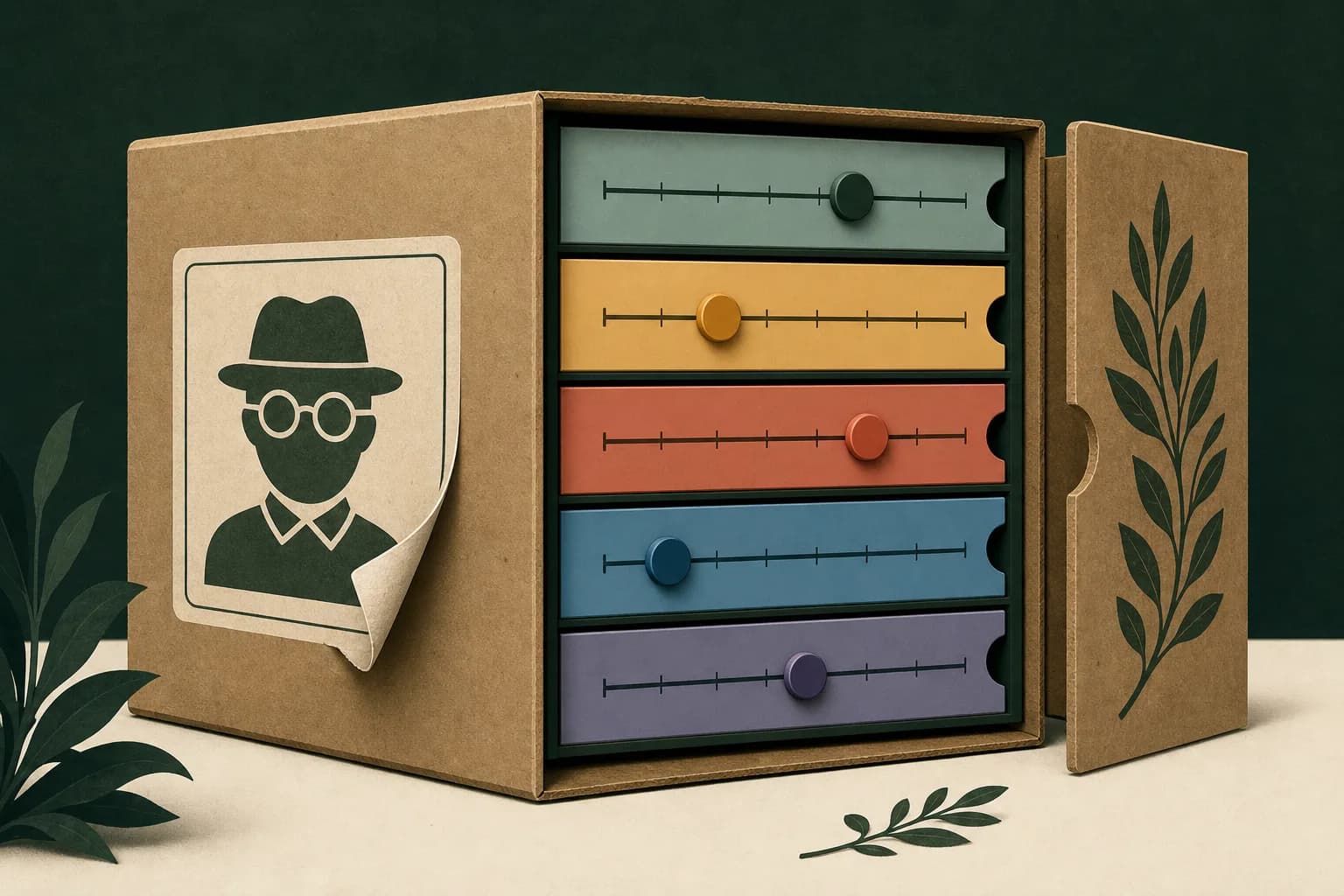
At some point, someone handed you four letters, or a number, or an animal, and said: this is what you are. And it felt good. Types always feel good. They arrive like a warm coat: here is your tribe, here are your strengths, here is a laminated explanation for why you are like this.
There is just one problem, and personality scientists have been shouting it politely for decades: the human personality does not come in types. It comes in dimensions. And the difference is not academic. It changes what your results actually mean and what you can do with them.
The seduction of the box
Type systems work like horoscopes work: they describe a recognizable pattern in warm, flattering language, and our brains do the rest. Psychologists call it the Barnum effect, our tendency to accept general descriptions as uniquely accurate portraits of ourselves.
But the deeper problem with types is statistical. Type systems require people to cluster into distinct groups: you are either an introvert or an extravert, a thinker or a feeler. When researchers actually measure large populations, those clusters simply are not there. Nearly every trait distributes along a bell curve, with most people near the middle. Cutting a bell curve down the center and declaring two "types" is like dividing humanity into Tall People and Short People at exactly 5'7". Someone at 5'6" and someone at 5'8" get opposite labels while being nearly identical.
This is why type-based results famously flip on retake. If you sit near the middle of a dimension, and most people do, a slightly different mood changes your letter entirely. You did not transform. The box was always the wrong shape.
What dimensions give you that types can't
The scientific model that survived a century of scrutiny, the Big Five, does something less cozy but far more useful: it gives you a position on five continuous dimensions. Openness, conscientiousness, extraversion, agreeableness, and emotional reactivity, each scored along the full human range.
The magic is in the middles and the mixtures. A type system has to round you to the nearest stereotype. A dimensional profile can capture the person who is highly organized but only moderately driven, deeply curious but socially reserved, warm with intimates and skeptical of strangers. That texture is where actual self-knowledge lives, because that texture is what your friends, colleagues, and partner are actually responding to.
Dimensions also predict. Your positions on the Big Five correlate meaningfully with career fit, relationship patterns, stress responses, and health behaviors, the kind of validity that typology has never demonstrated.
The two numbers people get most wrong
After scoring, people are most often shocked in two places. First, agreeableness: many who consider themselves kind discover they score low, because they confused politeness with agreeableness. The trait measures how much you prioritize harmony over candor, and plenty of good people run on candor.
Second, neuroticism, better read as emotional reactivity: people who think of themselves as calm sometimes discover high reactivity that they have been managing with elaborate control systems. The trait was not absent. It was expensive.
Findings like these are not insults. They are coordinates. You cannot navigate from a position you do not know you occupy.
Trade the coat for a map
Keep the four letters if they bring you joy. But treat them as a souvenir, not an instrument. If you want the version of self-knowledge that psychology can actually stand behind, you want five numbers on five dimensions, measured against the population, with the facets underneath each one.
The box told you what you are. The map shows you where you are, and unlike the box, it shows you the terrain in every direction: what is nearby, what would take work to reach, and which parts of your reputation were never accurate in the first place.
You have been wearing the coat for years. It takes about twenty minutes to get the map.
Turn insight into a personal profile
See how this pattern shows up in you
Take a related BeliefScope assessment for a structured result and an optional deeper report.
Related Insights
Why Some People Never Change (And the Trait That Decides If You Will)
Change is not about willpower. Research points to specific traits that decide who evolves and who repeats the same year fifty times.

The Hidden Motivation Behind Your Worst Habits, According to the Enneagram
Your most stubborn patterns are not random flaws. They are strategies protecting something specific, and naming it is the first real step to changing it.

Why You're Exhausted After Being 'On' All Day: The Introvert Tax Nobody Talks About
That specific tiredness after a social day is not weakness or bad sleep. It has a name, a mechanism, and a surprisingly practical fix.