
The Quiet Reason Family Dinners Turn Into Political Minefields
It is not the news cycle. The real reason political talk explodes at home is a hidden mismatch in moral wiring that nobody at the table can see.
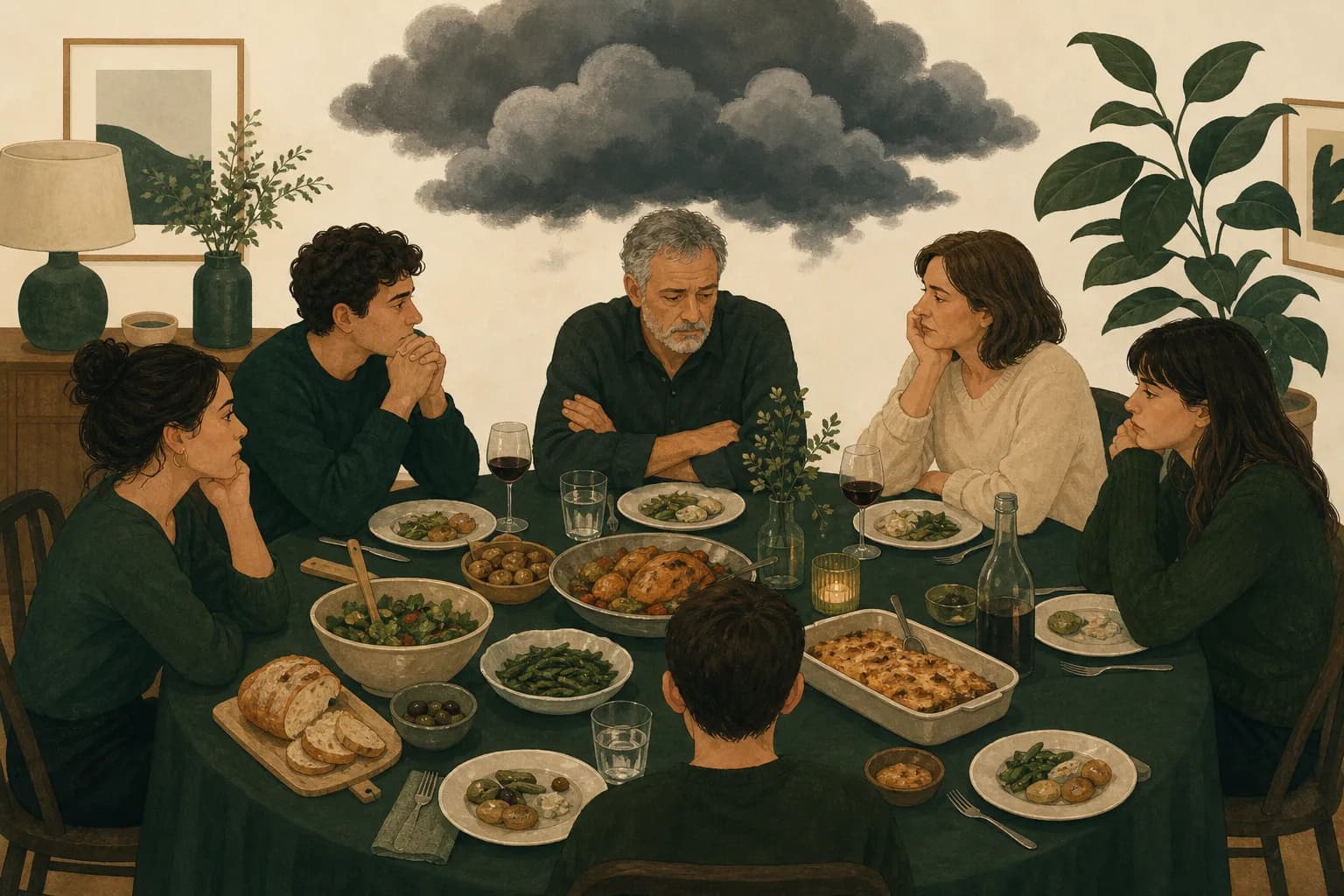
Every family has the topic. The one that turns a pleasant dinner into fourteen seconds of silence, a slammed cabinet, and someone announcing they are "just going to check on the kids." And every family has the same confused debrief afterward: how did we get there again? We agreed not to talk about it.
The standard explanation blames the news cycle, social media, or one particularly stubborn uncle. But research on political psychology points to something quieter and much harder to see: the people at that table are not actually arguing about the policy. They are colliding over moral foundations that were set long before anyone formed an opinion on any specific issue.
The argument beneath the argument
When your brother says something about immigration, or your mother mentions crime, the sentence you hear passes through a filter built from your deepest intuitions about fairness, loyalty, authority, harm, and freedom. His sentence was built by a different filter, weighted differently.
This is why political family fights feel so uniquely maddening. You are not disagreeing about facts, which could be checked. You are disagreeing about what matters, which cannot be settled by any article you forward to the family group chat.
Studies of moral reasoning consistently show that people on different ends of the political spectrum do not just reach different conclusions. They register different features of the same situation as morally relevant at all. One person hears a story about rule-breaking and feels the violation. Another hears the same story and feels the desperation that caused it. Neither is faking. Neither is stupid. They are running different moral operating systems.
Why family makes it worse, not better
Here is the cruel irony: political disagreement is most painful precisely with the people who share your history. A stranger with opposite views is an abstraction. Your sister with opposite views is a walking accusation, because you both started from the same kitchen table, and somewhere along the way one of you became someone the other does not fully recognize.
Psychologists note that family political fights are almost never about persuading. They are about a much more primal question: are you still one of us? That is why the tone escalates so fast. The stakes are not the tax rate. The stakes are belonging.
The mismatch nobody has mapped
Most families have never actually seen where each member stands, dimension by dimension. Everyone operates on caricature: dad is the conservative one, the cousin is the radical, you are the sensible middle. These caricatures are usually years out of date and were never accurate to begin with.
When people map their politics across multiple axes, something surprising happens inside families. The distances turn out to be different than everyone assumed. The "radical" cousin and the "conservative" dad often agree substantially on two or three axes and differ sharply on only one. The fight that felt like total war was actually a border dispute over a single province.
You cannot de-escalate a conflict you have not located. Knowing precisely where the disagreement lives, and where it does not, changes the conversation from "you have become someone I don't understand" to "we differ on this one axis, and we always have."
Before the next dinner
You do not need your whole family to take anything. Start with yourself. Most people discover their own profile is less predictable than the role they have been assigned at the table, and that discovery alone softens the script. It is very hard to play your part in the annual argument once you have seen evidence that the parts were miscast.
The dinner table fight is not going away because the news is not going away. But the difference between a family that fights blind and a family that knows its actual map is the difference between a minefield and a landscape.
Turn insight into a personal profile
See how this pattern shows up in you
Take a related BeliefScope assessment for a structured result and an optional deeper report.
Related Insights
Why You Can't Name Your Own Politics Anymore (And What That Says About You)
Millions of people no longer fit the labels they grew up with. Here is what political homelessness really means, and how to map where you actually stand.

The One Question That Predicts Your Politics Better Than Any Debate
Forget the hot takes. Political psychologists keep finding that a single underlying question splits people more reliably than any policy fight.

5 Signs Your Political Opinions Aren't Actually Yours
Inherited views feel identical to chosen ones, until you test them. These five signs reveal whether your politics are yours or just borrowed.